
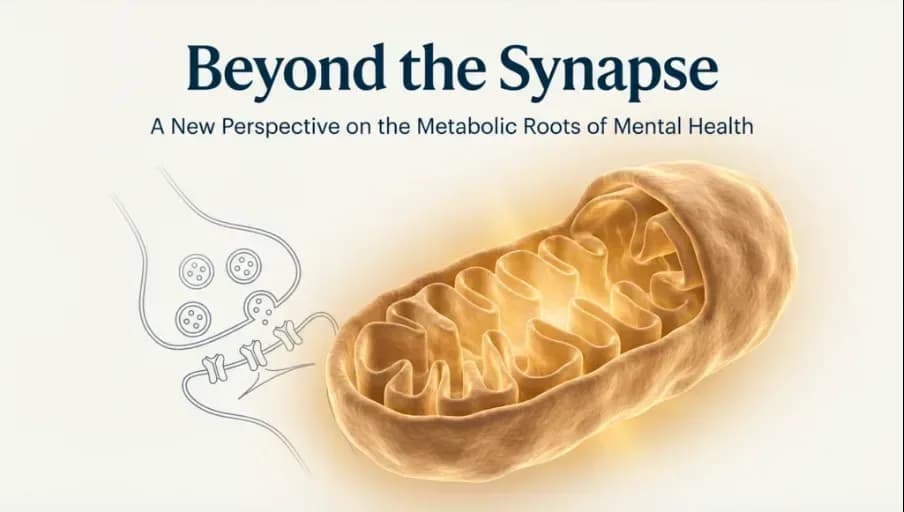
Metabolic Psychiatry: Integrating Bioenergetics into Mental Health Care
For decades, the dominant model in mental health has focused on the synapse—the junction between neurons. The prevailing narrative suggested that conditions like depression, anxiety, and schizophrenia stem primarily from imbalances in neurotransmitters like serotonin and dopamine. This chemical imbalance model gave us SSRIs and antipsychotics, which provide relief for many but not all patients.
[Image: image]
For the substantial number of patients defined as treatment-resistant, options can be limited. An emerging discipline known as Metabolic Psychiatry suggests that the traditional view is incomplete and asks a deeper question: What powers the synapse?
The Mechanism
A growing number of researchers, including Dr. Christopher Palmer at Harvard Medical School and others working in metabolic psychiatry, propose that many mental disorders may in part reflect metabolic disturbances in the brain. Neurotransmitters are the messengers, but mitochondria are the power plants that allow those messages to be generated and transmitted.
[Image: image]
When mitochondrial function is impaired—whether due to genetics, inflammation, insulin resistance, or other factors—the brain may lack the energy needed to regulate neurotransmitters and maintain cell membranes. This bioenergetic stress is hypothesised to contribute to symptoms we categorize as psychiatric: cognitive brain fog, emotional lability, and in severe cases, psychosis.
The Mechanism: How Ketones May Stabilise the Brain
Recent work has moved beyond theory to explore specific molecular pathways, although this research is still early. Studies suggest that the ketogenic diet does more than provide alternative fuel: it may also influence neurotransmitter systems. The primary ketone body, beta-hydroxybutyrate (BHB), can act as a signaling molecule. In experimental models, BHB inhibits certain histone deacetylases and other targets, which can shift gene expression in ways that increase GABA (the brain's main calming neurotransmitter) and decrease glutamate (the main excitatory neurotransmitter).
[Image: image]
Magnetic resonance spectroscopy (MRS) studies in mood disorders and related conditions have reported reductions in brain glutamate and changes consistent with enhanced GABAergic tone during ketogenic interventions, including an approximately 10–12% decrease in excitatory glutamate in key emotional regulation regions in some samples. Taken together, these findings support the idea that metabolic therapy may act like a mood-stabilising strategy by dampening excessive excitatory signalling, but larger and more definitive studies are still needed.
[Image: image]
From Theory to Data: The 2024–2025 Pilot Studies
Critics have historically pointed to a lack of rigorous clinical data. Recent years have brought several small but important pilot and open-label studies that begin to address this gap, while still falling short of definitive proof.
Schizophrenia & Bipolar Disorder
A four-month pilot trial at Stanford Medicine tested a ketogenic diet as an adjunct in adults with schizophrenia or bipolar disorder who also had metabolic abnormalities. Among participants who adhered to the diet, metabolic syndrome resolved in all cases, and psychiatric ratings improved by about 31% on the Clinical Global Impressions (CGI) scale, with roughly three-quarters showing clinically meaningful improvement—findings that suggest promise but require confirmation in randomised controlled trials.
Major Depression
In young adults with major depressive disorder, a ketogenic-style metabolic intervention (the KIND pilot) was associated with large average reductions (around 60–70%) in depression scores such as PHQ-9 over several weeks, again in an uncontrolled design. These improvements often emerged within the first two to four weeks, roughly paralleling the onset of nutritional ketosis.
Anorexia Nervosa
Case reports and a very small open trial of a therapeutic ketogenic diet in adults with chronic anorexia nervosa have suggested substantial reductions in eating and body-related fears, with several participants maintaining weight restoration and low symptom scores for at least 12 months. Authors emphasise that these data are preliminary and that larger, controlled trials are necessary before TKD can be considered an established treatment.
[Image: image]
Navigating Risks and Realities
Despite encouraging early findings, metabolic psychiatry is not a DIY cure-all, and ketogenic interventions should still be considered experimental in most psychiatric indications.
Medication Interactions
High-fat ketogenic diets can alter drug absorption and metabolism. For example, high-fat meals can markedly reduce the absorption of certain medications such as trospium, which is combined with olanzapine in Cobenfy, raising the possibility of subtherapeutic levels if dosing is not adjusted.
Metabolic Changes
While many patients experience improvements in weight, insulin resistance, and triglycerides, some show increases in LDL cholesterol or markers like homocysteine, underscoring the need for baseline and follow-up monitoring.
Monitoring
For patients with serious mental illness or eating disorders, expert supervision, laboratory monitoring (lipids, homocysteine, micronutrients), and coordination with existing psychiatric care are essential to maintain safety and medication efficacy.
[Image: image]
Systemic Future
For now, Metabolic Psychiatry is best viewed as a rapidly developing but still emerging field that adds a crucial physiological layer to existing psychological and neurochemical models. It moves the conversation from "Which chemical is low?" to "How is the brain's energy system functioning?"—especially for patients who have exhausted standard options, this reframing offers a new avenue for investigation and, cautiously, new hope.
[Image: image]
Disclaimer
This article is for educational purposes only and does not constitute medical advice. Metabolic and ketogenic interventions can significantly affect medications and physiology and should only be undertaken with appropriate medical supervision, ideally within a clinical or research setting.
References
1. Moncrieff, J., et al. (2022). The serotonin theory of depression: a systematic umbrella review of the evidence. Molecular Psychiatry. https://www.nature.com/articles/s41380-022-01661-0 2. UCL News. (2022). Analysis: Depression is probably not caused by a chemical imbalance in the brain. https://www.ucl.ac.uk/news/2022/jul/analysis-depression-probably-not-caused-chemical-imbalance-brain-new-study 3. Behavioral Health Business. (2023). Metabolic Psychiatry: A New Lens on Mental Health. https://www.behavioralhealthtech.com/insights/metabolic-psychiatry-a-new-lens-on-mental-health 4. Sethi, S., et al. (2023). Metabolic psychiatry: key priorities for an emerging field. University of Edinburgh Research Explorer. https://www.research.ed.ac.uk/en/publications/metabolic-psychiatry-key-priorities-for-an-emerging-field 5. Milenkovic, D., et al. (2023). Lactate: A Theranostic Biomarker for Metabolic Psychiatry? Frontiers in Psychiatry. https://pmc.ncbi.nlm.nih.gov/articles/PMC10526106 6. Norwitz, N. G., et al. (2024). The effects of ketogenic metabolic therapy on mental health and metabolic biomarkers: A systematic review. Frontiers in Nutrition. https://www.frontiersin.org/journals/nutrition/articles/10.3389/fnut.2024.1444483/full 7. Stanford Medicine News. (2024). Pilot study shows ketogenic diet improves severe mental illness. https://med.stanford.edu/news/all-news/2024/04/keto-diet-mental-illness.html 8. Sethi, S., et al. (2024). Ketogenic Diet Intervention on Metabolic and Psychiatric Health in Bipolar and Schizophrenia: A Pilot Trial. Psychiatry Research. https://pubmed.ncbi.nlm.nih.gov/38547601 9. D'Anci, K. E., et al. (2024). A pilot study examining a ketogenic diet as an adjunct therapy in major depressive disorder. PubMed Central. https://pmc.ncbi.nlm.nih.gov/articles/PMC12420795 10. Bostick, R., et al. (2025). A pilot study examining a ketogenic diet as an adjunct therapy in college students with major depressive disorder. Nature Translational Psychiatry. https://www.nature.com/articles/s41398-025-03544-8 11. Norwitz, N. G., et al. (2024). Therapeutic ketogenic diet as treatment for anorexia nervosa: A case series. Frontiers in Nutrition. https://pmc.ncbi.nlm.nih.gov/articles/PMC11409850 12. Scolnik-Brower, E., et al. (2024). Therapeutic ketogenic diet as treatment for anorexia nervosa. PubMed. https://pubmed.ncbi.nlm.nih.gov/39296512 13. News-Medical. (2024). Researchers propose ketogenic diet as a novel treatment for anorexia nervosa. https://www.news-medical.net/news/20240909/Researchers-propose-ketogenic-diet-as-a-novel-treatment-for-anorexia-nervosa.aspx 14. ClinicalTrials.gov. Impact of a Ketogenic Diet on Metabolic and Psychiatric Health: Study Record. https://www.clinicaltrials.gov/study/NCT05705063 15. Nutrition Network. (2023). Metabolic Psychiatry: Overview of Conditions. https://nutrition-network.org/research/other-conditions-2